In the often-fraught world of literary adaptations, an author's blessing is gold. But what happens when that blessing extends to a fundamental rewrite of the source material? That’s precisely the situation with Hulu’s new series, "The Testaments," a sequel to "The Handmaid's Tale," where legendary author Margaret Atwood not only approves of a significant narrative alteration but actively participates in its on-screen realization. It’s a compelling case study in how adaptation can evolve beyond mere translation, becoming a truly collaborative reimagining.
The series, which premiered on Hulu on April 8, 2026, picks up about four years after the conclusion of "The Handmaid's Tale," plunging viewers back into the chilling dystopia of Gilead. It continues the story of June Osborne's daughter, Agnes (Chase Infiniti), who was known as Hannah in the original series, and introduces a new character, Daisy (Lucy Halliday), presented as a convert to Gilead's strict ideology. What makes this adaptation particularly noteworthy isn't just its continuation of a critically acclaimed narrative, but the explicit sanction given by Atwood herself to a pivotal departure from her original novel.
Atwood's Full Endorsement and Active Role
For an author of Margaret Atwood's stature, whose work "The Handmaid's Tale" is a foundational text in speculative fiction, a nod of approval for an adaptation is significant. Her direct involvement with "The Testaments" goes much further. Atwood, months before the series debuted, revealed on her official website that she filmed a cameo for the show. "I have a cameo in ['The Testaments'], though I can't say as what, except that it's scowly," she wrote, clearly enjoying the secrecy. She later added, "I can't tell you what part I am playing — secret! — but it was a pleasure to work with the excellent team, and to watch the [marvelous] Ann Dowd in action as Aunt Lydia, alongside the very talented actresses playing the two young female leads. Can't wait to see the finished episodes!"
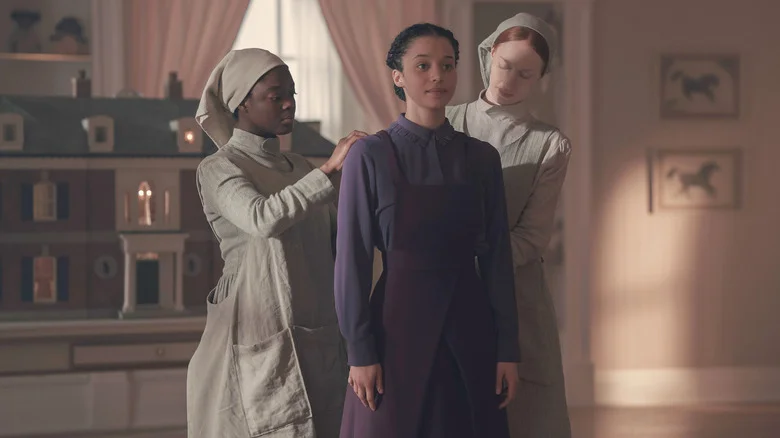
Her willingness to engage, and not just endorse from afar, sets a powerful precedent. Atwood's stance isn't one of rigid adherence to her text. As she told The Hollywood Reporter in May 2025, well before "The Testaments" premiered: "I'm not one of those authors who said, 'The necktie is wrong. I'm taking my name off the project.' I know the compromises you have to make, and you want somebody who's going to make the best ones." This perspective is crucial for understanding the depth of her trust in showrunner Bruce Miller.
Miller's Narrative Rationale: The Daisy Dilemma
Bruce Miller, who helmed "The Handmaid's Tale" and continues as showrunner for "The Testaments," is known for his close collaboration with Atwood. For the initial "Handmaid's Tale" adaptation, he famously operated under a "when in doubt, follow Margaret" policy, a strategy he found successful. "Not just out of fealty to her or to the book, but practically, she's a very good storyteller," he explained to The Hollywood Reporter.
However, for "The Testaments" series, Miller made a significant pivot. In Atwood's novel, the character Daisy is actually June Osborne's other daughter, Nichole/Holly, born when June was a Handmaid. The series fundamentally alters this, presenting Daisy as a young Canadian whose parents were tragically killed for their involvement with Mayday, the anti-Gilead resistance, before she's brought into Gilead.
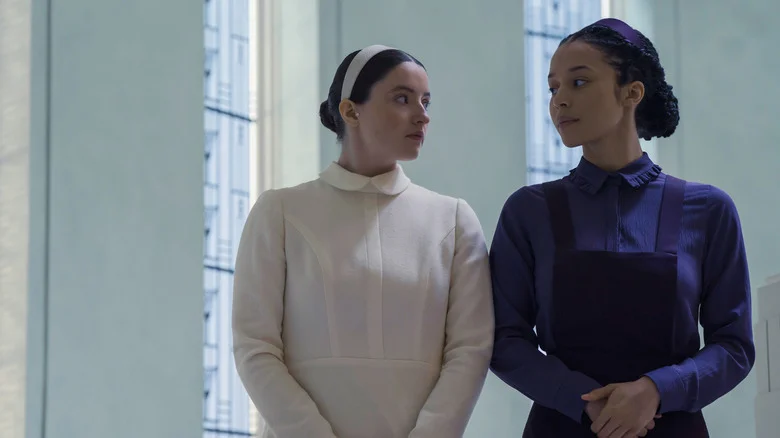
Miller's primary reason for this deviation was a practical one: a "timeline issue." He wanted Daisy and Agnes to interact physically within the narrative, rather than having their stories unfold 15 years apart as they do in the book. "I didn't want to make any changes at all, but I felt like I wanted to have Daisy and Agnes physically together, and not tell their stories 15 years apart like they do in the book," Miller clarified. While Nichole/Holly still exists as a child within the series' continuity, with "little hints that she's out there," the decision to redefine Daisy creates immediate dramatic potential for the show, allowing for dynamic interactions between the two young leads, Chase Infiniti and Lucy Halliday.
Beyond Fidelity: The Art of Adaptation
This willingness to diverge from the source material, particularly with the author's blessing, offers a fascinating lesson for anyone tracking the evolution of storytelling across mediums. The instinct might be to view a major plot change as a betrayal of the original text, but in this instance, it appears to be a considered move to enhance the televised narrative. The screen demands different pacing, different opportunities for character dynamics, and often, a compression or expansion of timelines that static text can handle more fluidly.
Atwood's active collaboration with Miller underlines a shared understanding that what works on the page doesn't always translate directly to the screen. Her "necktie" analogy speaks volumes about the pragmatic compromises necessary in adaptation, where the core spirit and message must remain intact, even if specific plot mechanics shift. This isn't a case of an adapter running wild; it's a mutual decision, born from a deep respect for the story and its potential to resonate with a new audience through a different format.
The Road Ahead for Gilead's Saga
The collaborative spirit between Atwood and Miller, exemplified by her enthusiasm and his tactical deviations, promises a "The Testaments" that is both faithful in spirit and innovative in execution. This dynamic allows the series to explore new facets of Gilead's collapse and the lives forged within its oppressive beauty, and for characters like Agnes and Aunt Lydia (Ann Dowd) to evolve in compelling ways. It also means that the potential for June and Agnes to finally reunite on screen, a deeply anticipated moment for fans, remains very much alive, with the author's full support.
Ultimately, "The Testaments" serves as a powerful demonstration that the most successful adaptations aren't necessarily carbon copies, but rather creative transformations. When an author of Atwood's caliber trusts a showrunner enough to empower them to reshape the narrative for the screen, the result is a testament to shared vision and the enduring power of a story to adapt and thrive across different mediums.