The Unlikely Phenomenon of Andy Weir's "The Egg" and Its Enduring Digital Life
There’s a fascinating dynamic at play in how ideas take root and spread in our interconnected world, especially when they bypass traditional gatekeepers. Take Andy Weir's short story, "The Egg." This isn't one of his meticulously researched, blockbuster-ready novels like "The Martian" or the forthcoming "Project Hail Mary." Instead, it's a quick, philosophical thought experiment, something Weir himself admits he "banged out in about 40 minutes" back in 2009. Yet, this eight-page tale has quietly become a global phenomenon, spawning a surprising number of adaptations and resonating with millions, arguably more profoundly than some of his big-screen projects.
The story's premise is deceptively simple: A 48-year-old man dies in a car accident and encounters a cosmic "being" — essentially, God. This being reveals that the man is about to be reincarnated as a Chinese girl in AD 540. Here's the kicker: the man, in fact, is the *only* soul in the entire universe. Over an unimaginably long timeline, this single soul experiences every life ever lived on Earth. Jesus, Abraham Lincoln, every Holocaust victim, every person you've ever loved or harmed — they are all you. Once every human experience has been processed, this sole soul will ascend to godhood. The universe, in this framework, is a "god egg," with human history serving as its vast gestational period.
The Author's Intent vs. Audience Interpretation
What's truly remarkable here isn't just the story itself, but Weir's own humble distance from its profound reception. In an interview with Grimdark Magazine, he expressed surprise at its popularity, stating he never intended it to be a significant theological text. "I didn't expect it to be significant," he said. "It was just one of many short stories I wrote in that period. Then it blew up and got really popular." He’s even had to tell readers who believe "The Egg" is literally true that it's "just a story I made up. I also don't believe there's a guy stranded on Mars. These are just stories."
This contrast between creator intent and public interpretation is fascinating. Weir, a writer known for his meticulous scientific grounding, tossed off a piece of speculative philosophy, and it struck a deep chord. People aren't just reading it as fiction; they're connecting with its message of universal interconnectedness, a concept with roots in countless ancient spiritual traditions. The idea that every person you encounter is, in essence, you, often inspires a profound sense of empathy and a desire for greater kindness. It suggests that a simple, compelling idea can transcend its author's pragmatic view and take on a life of its own, becoming a catalyst for reflection and perhaps even behavioral change.
Kurzgesagt: The Catalyst for Viral Reach
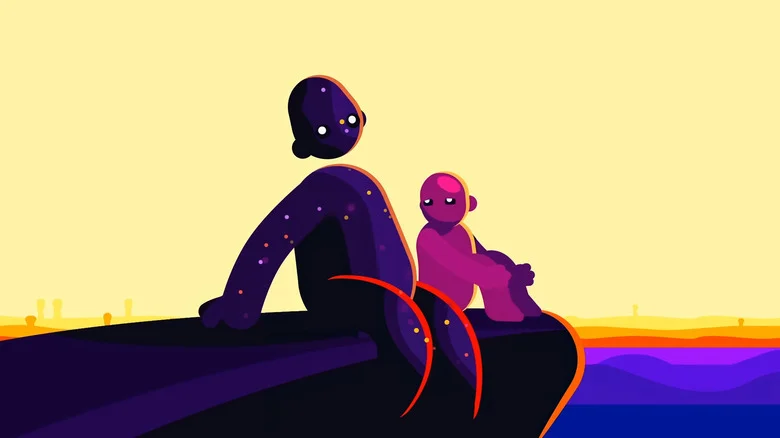
While "The Egg" existed as a text for a decade, its true explosion into mainstream consciousness largely came in 2019, courtesy of the German animation studio Kurzgesagt. Known for their distinctively clean, dreamy, and contemplative style, Kurzgesagt adapted the story into an eight-minute short film as part of their "Kurzgesagt: In a Nutshell" YouTube series. Directed by Philipp Dettmer, with a script adapted by James Gurney and narrated by Steve Taylor, this animated version, made with Weir's blessing, is freely available on YouTube.
The choice of Kurzgesagt as an adapter was inspired. Their signature aesthetic — beautiful, minimalist animation paired with clear, evocative narration — is perfectly suited to conveying abstract, philosophical concepts. They've built an audience eager for accessible explanations of complex ideas, from the physics of black holes to existential questions about humanity's future. Presenting "The Egg" in this format made its profound message digestible and emotionally resonant for a vast, global audience. The accessibility of YouTube, combined with Kurzgesagt's production quality, transformed an already impactful short story into a viral sensation, one that's easily discoverable and shareable.

A Global Canvas for Independent Filmmakers
The Kurzgesagt version might be the most widely seen, but it's far from the only adaptation. "The Egg" has proven remarkably fertile ground for filmmakers across the globe, a testament to its universal appeal and relatively simple structure. IMDb lists numerous other adaptations, from the 2012 Swedish short "Ägget" by Hjalmar Ekström Wikander and Tage Wikander Hervén, to a 2025 film titled "I, God" by Matija Max Vidovich. In between, we've seen versions by Daniel Banchik Herranz (2023), Fred Grant (2020), Andrej Dojkic (2019), Timothy Judd (2018), Nataliia Weaver (2018), and Josef Orlandi (2015). This flurry of international, independent interpretations underscores the story's adaptability and its ability to transcend cultural boundaries.
The story's diplomatic approach to religion likely contributes to its broad appeal. When the protagonist learns he's to be reincarnated, his immediate thought is, "So, the Hindus were right." The supreme being's response is a unifying, "all religions are right 'in their own way.'" This inclusive stance allows audiences from various backgrounds to engage with its core philosophical ideas without feeling alienated.

What "The Egg" Tells Us About Modern Storytelling
The story of "The Egg" isn't just about a good idea; it's a case study in how intellectual property can thrive in the digital age. Here’s a piece of fiction, written almost on a whim, that has achieved a cultural footprint arguably as significant, in its own way, as Weir's more commercially successful and big-budget adapted novels. While "The Martian," directed by Ridley Scott in 2015, and the Phil Lord and Christopher Miller adaptation of "Project Hail Mary" in 2026 are studio tentpoles, the Kurzgesagt version of "The Egg" stands as a testament to the power of accessible, high-quality independent content. It shows us that a concise, thought-provoking narrative, distributed freely on platforms like YouTube, can find a massive audience and spark ongoing creative engagement globally.
The journey of "The Egg" suggests that what truly resonates with people, often, isn't just spectacle or scientific accuracy, but an accessible exploration of fundamental human questions. Weir, for all his scientific prowess, has a penchant for whimsy and a belief in humanity's capacity for good humor even in the face of cosmic scale. His short story embodies this spirit perfectly. It challenges us to reconsider our place in the universe and our relationship to one another, all within a surprisingly compact and potent package. It's a reminder that sometimes, the most impactful stories are the ones that invite us to look inward, even if they started as mere scribbles on a page.
You can watch the Kurzgesagt adaptation today: The Egg by Kurzgesagt